

IT News on November 12: At the Adobe MAX 2026 conference held on November 10 local time in the United States, Adobe announced an expansion of support for Windows, on, and Arm. Starting from version 22.0, the typesetting software InDesign and the document editing software InCopy now support ARM64 natively.
Adobe officially stated that starting from version 22.0, on Windows devices equipped with Snapdragon X series processors, the typesetting software InDesign and the accompanying document editing tools InCopy no longer rely on emulation conversion and can run natively on the device. For creators using Snapdragon laptops, this means that these two publishing tools have evolved from "compatibility mode" to direct adaptation to the chip architecture.
In terms of system requirements, IT cites a blog post that states the minimum processor configuration required is Snapdragon X Elite X1E -78-100 (with a maximum of 3.4 GHz, 12 cores), which supports Advanced Vector Extensions 2 (AVX2), and works in conjunction with Qualcomm's Adreno graphics processor.
The operating system must be at version 26100.7623 of Windows 11 24H2, or version 26200.7623 of 25H2. If an 0xc0000142 error occurs during startup, it is recommended by the official to update to Windows 11.
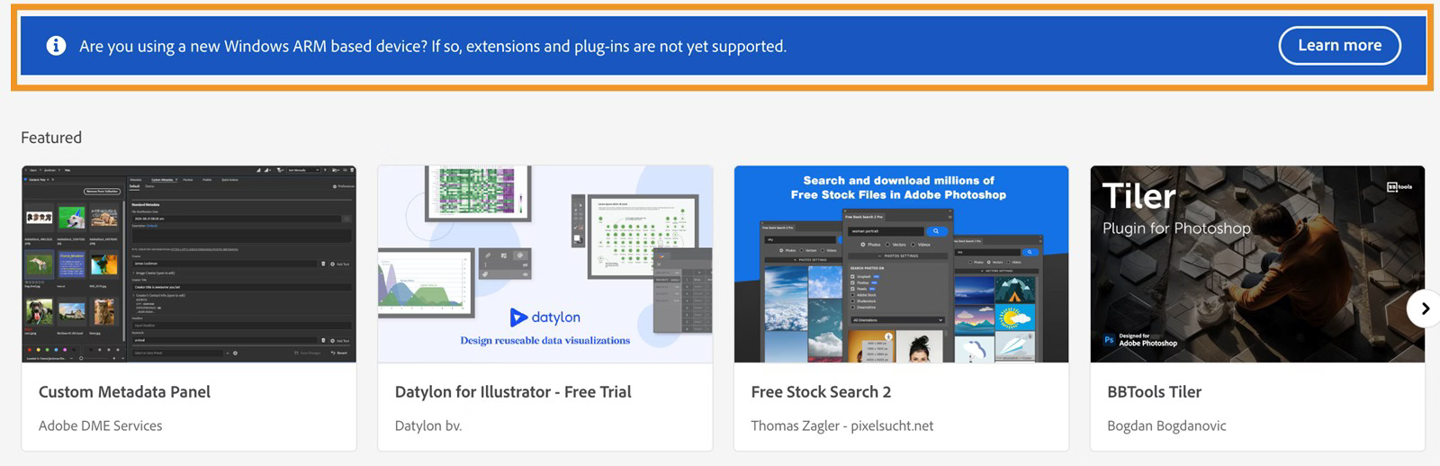
There are still limitations to native adaptation. Currently, the Windows, on, and Arm platforms do not support relevant extensions and plugins, and the Creative Cloud desktop applications will not display the corresponding plugin entries. In addition, to import HEIC and HEIF images, it is necessary to install both the HEIF image extension and the HEVC video extension.

At the same time, the Photoshop, Premiere, After Effects, and Substance 3D Painter beta versions have been optimized for high-performance Arm computers. The display platforms include those equipped with NVIDIA RTX Spark and Surface Laptop Ultra.