




Editor's Note:U.Today The author's views represent only themselves and do not represent the stance of U.Today. U.Today The financial and market information provided is for reference only and does not constitute investment advice. U.Today No responsibility is assumed for any financial losses resulting from trading cryptocurrencies. Please consult a financial expert for independent research before investing. We believe that as of the date of publication, all content is accurate, but some of the discounts mentioned may no longer be applicable.
Brief
- Solana ( SOL ): Selling pushed prices down to the $80 support level
- Gram ( GRAM ): Durov's wallet messages drive a strong price rebound
- Hyperliquid ( HYPE ): Positive news failed to stop the decline
- Bitcoin ( BTC ): ETF Capital outflows and weakening catalyst factors are suppressing prices
Brief
- Solana ( SOL ): Prices have fallen by more than 30% since September, and if the support at $80 is broken, they could test $70.
- Gram ( GRAM ): Driven by news from the Durov wallet, the price rebounded to $1.244, but there is strong resistance around $1.25.
- Hyperliquid ( HYPE ): Despite the positive news, the price remains trapped in the $70 to $73 range. The $68 level near the 200-day moving average may provide support.
- Bitcoin ( BTC ): The price is reported at $73,535, down 16% from the high in September. ETF Capital outflows and weakening catalytic factors continue to exert pressure.
Solana ( SOL ): Selling pushed prices down to the $80 support level
Solana is currently trading at $83.66. The price has returned to the range where the upward trend began in August.
The Solana downtrend we are seeing now is not a normal correction. Since September, its price has fallen by more than 30%, with the trading price at that time being $125. Under normal circumstances, for high-volatility assets including cryptocurrencies, the correction range tends to stop around 10%. But this time it is different.
By the end of October, Solana broke below the black moving average on the chart, which is the 200-day moving average, indicating that the long-term trend may have changed. When the short-term moving average crosses below the long-term moving average, it suggests that the bearish trend is worsening.
The next support level is around $80, with a lower support range between $72 and $78. This range is exactly where SOL stayed throughout July, before breaking upwards in mid-August. Under such strong pressure, it is unlikely that the $80 level can be held, so traders should not be surprised if trades around SOL occur in the vicinity of $70.
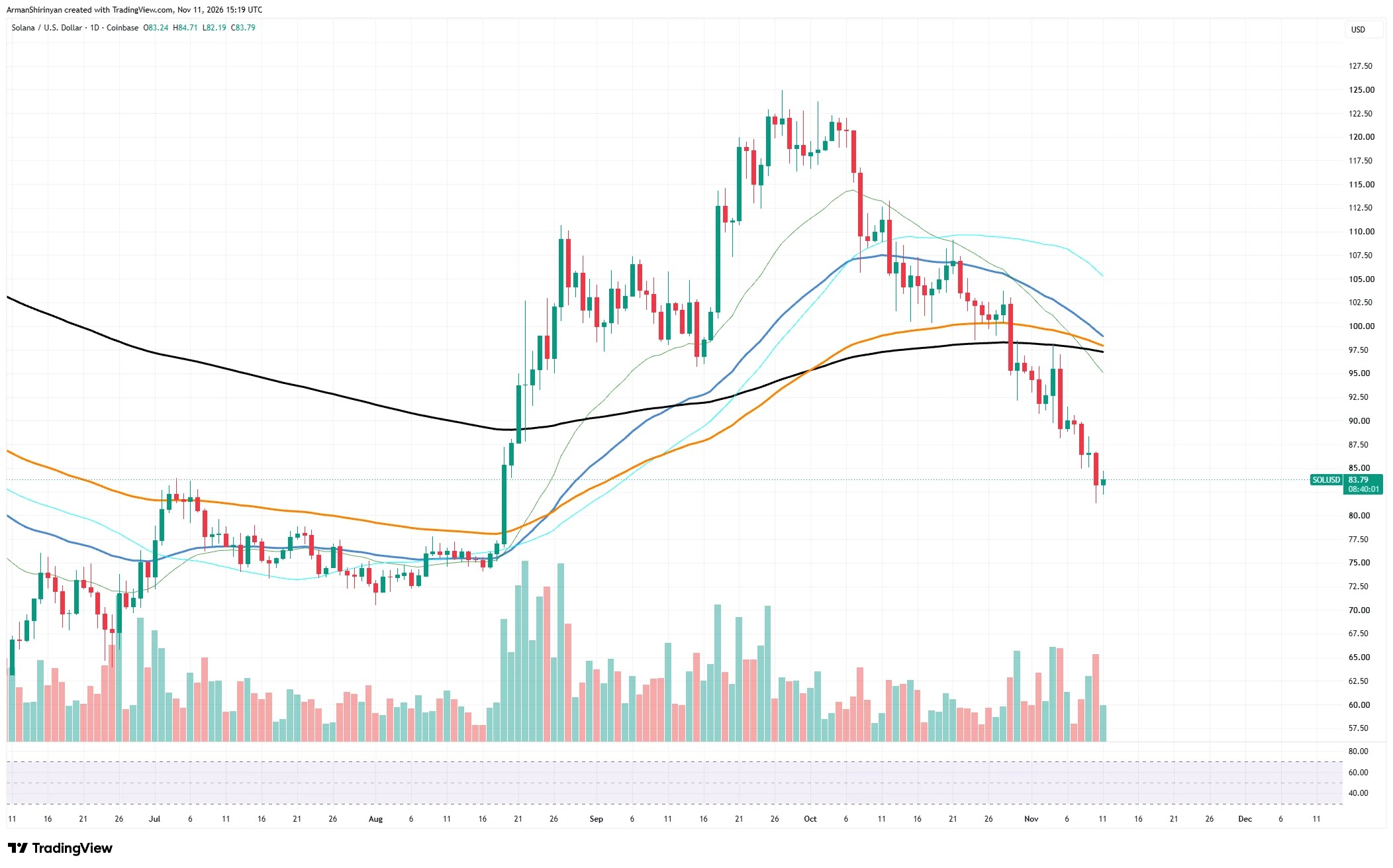
On November 10th, trading volume soared, which basically confirms that the downward trend continues.
Gram ( GRAM ): Durov's wallet messages drive a strong price rebound
Gram is currently trading at $1.244, and on November 9th, it briefly fell below $1.
Driven by the speech of Pavel Durov on X, Gram has seen a significant boost: it rose by 24% within three days, and on the most recent trading day, its K-line indicated another increase of 9%.
The starting point of this rebound came from the update to the Telegram wallet, as well as the further direct integration of blockchain technology into this communication app, coupled with speculative buying. Durov stated that Telegram users created over 700,000 Gram wallets in the past 48 hours.
The record trading volume on November 10th may reflect concentrated buying, which means that someone or a certain group directly purchased GRAM and invested funds in it.
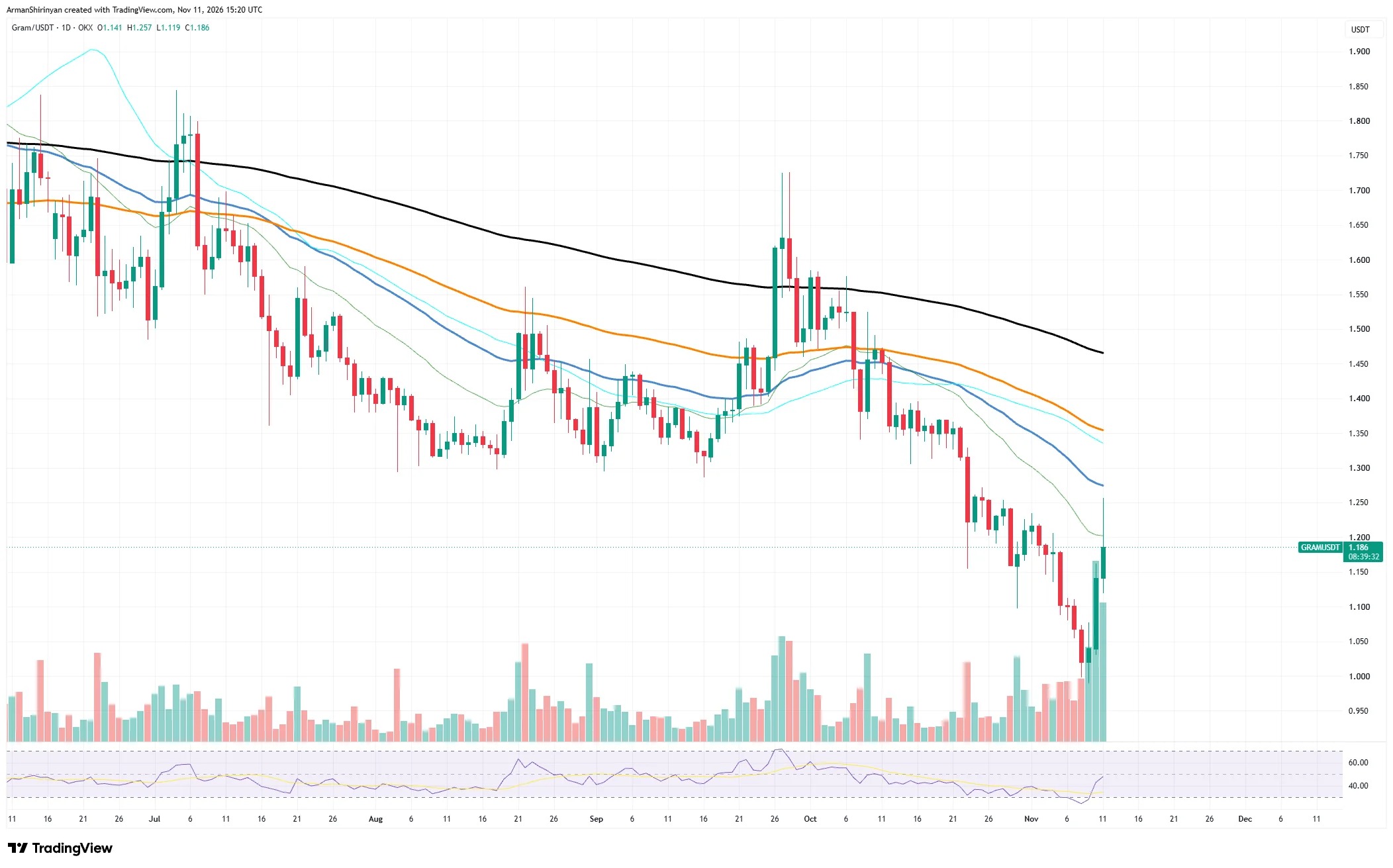
The price has broken above the short-term green moving average, around $1.21. Unfortunately, the resistance is quite strong: the resistance level tracked from October to November is around $1.25. Other moving averages may continue to put pressure on bears around $1.34 and $1.46.
In late September, GRAM soared to around $1.73, but failed to maintain the upward trend and quickly fell back below the black moving average.
The current rebound is driven by both speculative and fundamental factors, hence its subsequent trend remains uncertain.
Hyperliquid ( HYPE ): Positive news failed to stop the decline
Despite some recent positive developments for Hyperliquid, such as its listing on a South Korean exchange on November 10th and ongoing share repurchases, HYPE continues to decline. This asset has seen a cumulative drop of about 14% this week.
In addition, on October 29th, Hyperliquid announced the launch of US futures based on Hyperliquid, which caused its price to rebound to $97 for a while. However, this did not have the desired effect, and since then, HYPE has fallen by nearly $25.
From a price perspective, the only positive development is that in August, the price broke through the 200-day exponential moving average, which could potentially become a support level in the future, but this has not yet been realized.
Currently, Hyperliquid is trapped in the range of $70 to $73. It seems that it will be difficult to break through upwards unless the price first falls back to the 200-day moving average of around $68 and then rebounds from there.
Bitcoin ( BTC ): ETF Capital outflows and weakening catalyst factors are suppressing prices
Bitcoin is currently trading at $73,535, which is a 16% decline from its September high. Unfortunately, the current market is very brutal and clearly shows strong pressure.
Since the beginning of November, approximately $1.6 billion has flowed out of Bitcoin spot ETF, although this situation is starting to improve. According to a Eric Balchunas from Bloomberg, only stock funds have recorded the largest inflows of capital, indicating that funds are still continuing to flow from digital gold into more traditional assets.
The more suitable time to buy Bitcoin may have to wait until the overall market recovers, which also means waiting for better market catalysts to appear. However, such catalysts do not exist at present.
The growth in demand for IPO of Anthropic, as well as the rapid progress of AI, is attracting investors away from the cryptocurrency industry. Over the past two years, the crypto industry has been in a state of distress, lacking catalysts, security, and practical applications.