

Tangem Is the wallet secure? There's no need to memorize a mnemonic phrase. Tangem What exactly protects the assets in this wallet? It encloses the private key generation and signing processes within the secure chip of a single card, replacing the traditional paper-based recovery phrases with multiple physical backup cards. Whether this design actually lowers the barrier for beginners or merely hides the risks more deeply needs to be examined from three perspectives: mechanism, incidents, and real threats.
What is a wallet? (Tangem)
Tangem Wallet is a card-based, self-hosted hardware wallet that is based on NFC. It has no screen, no battery, and no USB interface. The private key is generated and stored within the secure element chip of the card. To sign transactions, one simply needs to tap the card against a smartphone that supports NFC. Below are the Tangem Wallet details we have compiled from publicly available market information:
| Data items | Numerical values |
|---|---|
| Official pricing for the 2-card set | $109.99 |
| Official pricing for the 3-card set | $139.99 |
| Security Chip Certification Level | Common Criteria EAL6 + |
| First firmware audit | In August 2018, Kudelski Security |
| Second hardware/firmware audit | December 2023, Riscure |
| Mobile SDK Audit | March 2026, Cure53 |
| Supported token quantity | Over 16,000 varieties |
| Supports blockchain networks | More than 87 items |
| Laser Vulnerability Laboratory Costs | Approximately $250,000 |
| Cumulative Card/Wallet Issuance | Over 6 million |
What's the difference between Tangem wallet and a regular wallet?
In our view, the most fundamental difference between it and traditional hardware wallets lies in the backup method:
Under the Tangem standard settings, users are not required to copy a mnemonic phrase of 12 or 24 words. Instead, through chip-to-chip encrypted data exchange between 2 to 3 cards from the same set, the same private key is copied onto each backup card, allowing any single card to independently unlock the same wallet.
What are the available options for Tangem wallets?
Current mainstream products include a 2-card set for about $54.90, and a 3-card set for about $69.90. In addition, there are also multi-wallet combinations such as the ring-shaped Tangem Ring (which comes with 2 cards) and family packs. The cards use security components supplied by Samsung, with an authentication level of Common Criteria EAL6+, which belongs to the same security family as biometric passport chips. They support over 16,000 types of tokens and more than 80 blockchain networks. There is no Tangem-related transaction fee for sending transactions; users only need to pay the fees of the respective blockchain networks.
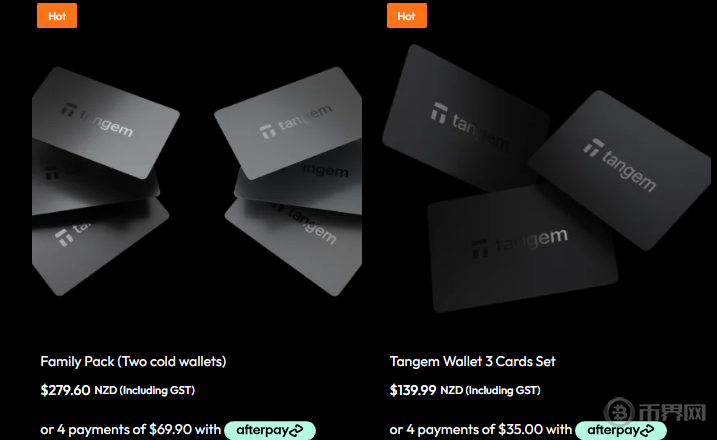
Tangem Wallet Products
What are the advantages of the Tangem wallet?
It removes the most error-prone step for beginners.
In our view, the leakage of mnemonics is one of the main pathways for the theft of crypto assets. For example, in the first half of 2025, the losses resulting from the leakage of mnemonics and private keys amounted to approximately $1.71 billion. Tangem ensures that private keys do not take a form that can be easily “copied,” thereby eliminating the entire category of attacks involving taking photos of keys, using cloud notes, or entering mnemonics on phishing websites at the source. For beginners who lack experience in secure storage, this is a real benefit.
Ultra-low friction is utilized.
In our actual tests, we found that the setup process for the Tangem wallet usually takes between 2 to 3 minutes. There is no need for a computer, no need to install any desktop software, and no need to manage firmware updates. Simply download the App, scan the card, and set up the access code to get started using it. The interactive method of touch signatures with NFC is particularly user-friendly for those who are not familiar with USB devices and button operations. The card itself is waterproof and durable, does not require charging, and its portability is significantly better than that of traditional hardware wallets that require carrying cables.
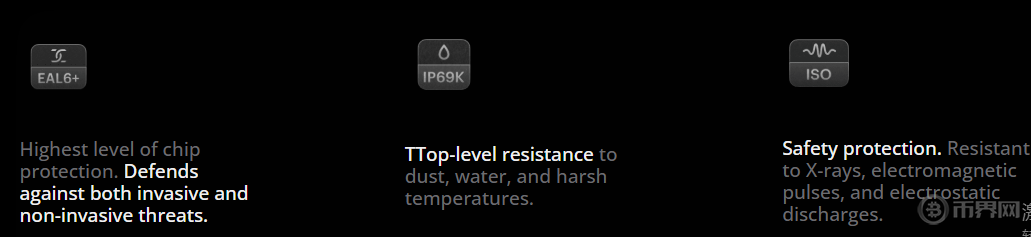
Tangem Wallet Advantages
Tangem Is the wallet secure?
To conclude first: We believe that under the premise that 'the private key does not touch the internet and an attack requires physical contact', Tangem is safe for ordinary users; its risk does not come from remote theft, but rather from the operational error of losing all backup cards at once.
Chips lock private keys; physical cards replace mnemonics.
The security logic of Tangem is built on two layers.
The first layer is the chip: The private key is generated and stored within Samsung's security components on the card, with an authentication level of Common Criteria EAL6+, which is on par with biometric passport chips; the firmware has undergone independent audits by Kudelski Security and Riscure, and no backdoors were found.
The second layer is the backup method: which means that any of the wallets mentioned in our previous text can be accessed independently by users, who do not need to copy or enter mnemonic phrases. This eliminates from the very beginning the entire category of attack vectors such as "mnemonic phrases being photographed or entered through phishing."
Disclosed Risks: Two Things Need to Be Clearly Distinguished
Laser Vulnerability (July 2026)
Ledger Donjon reveals that with a single laser pulse combined with an opening operation, it is possible to reset the password of a Tangem card without knowing the original password. However, Tangem responded that "the actual risk faced by ordinary users is almost zero," and emphasized that there have been no real cases of asset loss as a result to date.
Customer service data breach (October 2026)
Tangem Reveals that a third-party customer service system was accessed without authorization, potentially leading to the leakage of some customers' names and email addresses; hardware wallets, private keys, and encrypted assets were not affected. The real risk lies in the possibility that the leaked contact information could be used to create phishing emails pretending to be from the “Tangem official customer service,” rather than the direct remote transfer of assets.
One thing beginners need to pay the most attention to: backup cards should not be stored in one place.
As long as there is at least one card left, access to the assets can be maintained normally; if no mnemonic phrase is enabled during setup and all cards are lost, the funds will be irretrievable permanently, and even Tangem cannot help in that case. Conversely, if you forget the access code for a certain card, you can use another card from the same set to perform a reset, provided that you have at least two devices available.
For beginners, a habit that is even more crucial than "more secure due to multiple chips" is: the first thing to do after receiving the cards is to place 2 to 3 of them in different physical locations, rather than keeping them all in the same drawer or the same bag.
Conclusion
In our view, the security framework of the Tangem wallet is clear: private keys are isolated at the chip level, and there is multi-card redundancy for physical backups, eliminating the most common path to leakage that beginners often fall for by not writing down their mnemonic phrases. However, its promise of “safe use” comes with a prerequisite: you must treat the management of your decentralized backup cards with the same seriousness as you did when you first wrote down those mnemonic phrases. While tools save you the need for pen and paper, they do not replace the need for careful management of physical backups. For beginners who are willing to take on this responsibility, the Tangem wallet is a practical choice; for those who are not, no matter how advanced the chip technology, it cannot make up for poor operational habits.
Tangem FAQ on Wallet Issues
Q1: What should I do if I lose my Tangem wallet?
If only one card is lost and you still have other backup cards, your assets will not be affected at all; you can use the remaining cards to access and trade normally. If you suspect that the lost card may have fallen into the hands of someone else, the safest approach is to create a new wallet and transfer your assets there, as the lost card still contains a copy of your private key.
Q2: Can I still retrieve the access code for Tangem if I forget it?
With the access code recovery function enabled, another card from the same set can be used to reset a forgotten access code. This operation requires at least two devices. If the user has manually disabled this function, then it is not possible to reset the access code using a backup card, and the user must rely on remembering the original access code.
Q3: Should beginners choose Tangem or Ledger?
Consider the priorities. If "not touching mnemonics, quick setup, and portability" are the main requirements, then Tangem is more suitable for beginners: it's ready to use immediately upon touch, setup takes 2-3 minutes, and the 3-card set comes with built-in backup. If you place more importance on "personally verifying the details of each transaction on the device screen," then Ledger offers a more intuitive verification experience with its built-in screen during complex contract interactions, but it requires managing mnemonics, installing desktop software, and dealing with firmware updates, which significantly increases the learning curve.
The above content is an analysis of "Is the Tangem wallet secure? Can beginners use it with confidence without having to memorize a mnemonic phrase?" For the latest information, please follow CoinMeta.
Disclaimer: Readers are kindly requested to strictly comply with the laws and regulations of their respective jurisdictions. The content of this article is compiled based on publicly available market information for reference only and is intended for informational purposes and learning research purposes only. It does not constitute investment advice.