

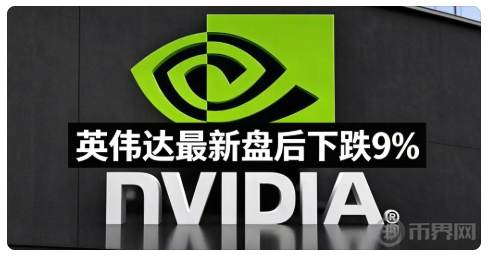
NVIDIA tumbles 9% after the announcement, does the story of computing power in the AI industry need to be rewritten? Not necessarily.CoinMetaOn November 12th, according to data statistics, NVIDIA's stock price plummeted during after-hours trading in the U.S. market, with the decline once expanding to 9%. It closed down about 8.6% at $158.76 per share. Microsoft's stock price surpassed NVIDIA's. The direct trigger was not a lack of demand for its chips, but rather the board of directors was considering removing Jensen Huang and had already begun looking for a successor. This time, the impact of NVIDIA's stock price drop on the AI industry is not related to the demand side, but rather to a more concealed aspect: as the governance stability of the guarantors begins to waver, the financing foundation for the expansion of computing power is also being reevaluated.
Table: Latest Relevant Data on NVIDIA Stock
| Data items | Numerical values |
|---|---|
| Post-market decline | 8.6% |
| After-hours closing price | $158.78 |
| Closing price during regular trading hours | $173.73 |
| One-day market value evaporated | Approximately $361 billion |
| Post-market market value | Approximately $3.834 trillion, ranking 3rd in the world. |
| Total scale of financial commitments | 165 billion US dollars |
| Ohio data center related amounts | 105 billion US dollars |
| Financing needs of three new cloud service providers | 124 billion US dollars |
| NVIDIA's market share in China's AI acceleration cards is expected to accelerate by 2025. | 55% |
| Goldman Sachs Global AI Capital Expenditure Forecast | Approximately $2.008 trillion in 2028 |
Explanation: The above contentCoinMetaCompiled and summarized based on public market information. In case of any fluctuations, please refer to the actual situation.
Why did NVIDIA's stock suddenly fall after the market closed?
NVIDIA's stock price fell 9% after the market closed, and we believe that the direct trigger is related to governance issues.
According to Bloomberg and The Wall Street Journal, NVIDIA's board of directors held an internal meeting on Wednesday to discuss the future of CEO Jensen Huang, and has collaborated with external organizations to select candidates for the new CEO position, even considering appointing a temporary CEO during the transition period. Polymarket data shows that market bets on his resignation before November 30th once rose to 86%.
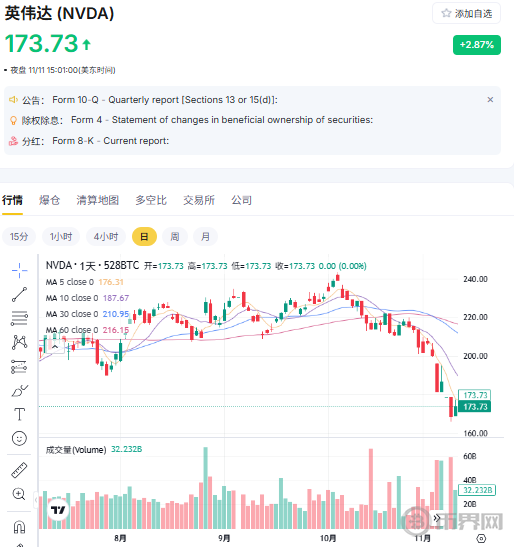
NVIDIA's latest stock price
In addition, we have analyzed the background at a deeper level:
NVIDIA doesn't just sell chips; it also acts as a guarantor for its customers and helps them attract investments. For example, in a data center project in Ohio, NVIDIA was involved with approximately $105 billion; three emerging cloud providers, CoreWeave, Nebius, and IREN, will need to spend around $124 billion over the next year or so to expand their operations. They don't have that much money on their own and have to borrow it, and to a large extent, they are willing to do so because of NVIDIA's reputation.
Now that NVIDIA has its own problems, and the board of directors is considering removing Jensen Huang, the company's internal stability is compromised. The market will then wonder: Does NVIDIA's previous commitment to act as a guarantor and help with financing for others still hold? As a result, people start selling their stocks as a precaution. Therefore, the decline in stock prices is not due to a lack of demand for chips, but rather because "the person who supported the downstream customers" can no longer stand firm.
What are the impacts of the decline in NVIDIA's stock price on the AI industry?
NVIDIA's stock price fell by 9% after the market close. The impact on the AI industry can be divided into three aspects.
Opportunity Window for Domestic Chips
NVIDIA's internal instability caused the stock prices of domestic companies producing AI chips to rise immediately.
In the morning session on November 12th, Cambricon's stock price rose by over 11%, returning to the thousand-yuan mark; domestic companies such as Muxi Shares, Moore Threads, and Haiguang Information also saw increases. We believe the reason is straightforward: domestic cloud service providers and AI enterprises are concerned about the instability of NVIDIA's supply and cooperation in the future, which motivates them to advance the testing and procurement of domestic chips.
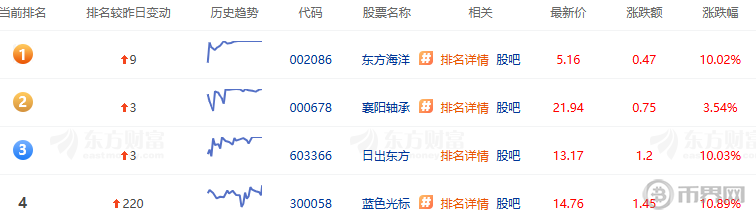
Domestic AI Stock Price Increase Ranking
Trends can also be observed from the data: By 2025, the shipment of AI graphics cards in China is expected to reach approximately 4 million units, of which domestic manufacturers will account for 1.65 million units, marking the first time their share exceeds 40%, while NVIDIA's share drops to 55%.
Although domestic chips face more opportunities, there are still three major challenges: HBM memory supply, advanced manufacturing process capacity, and the costs associated with migrating from the CUDA ecosystem. These issues will not disappear just because NVIDIA's stock price drops once.
AI It's becoming harder for startups to raise funds.
NVIDIA’s shares fell by 9% after the announcement, making it more difficult for AI startups to raise funds. Let’s look at two examples:
OpenAI originally intended to raise at least $30 billion with a valuation of $1.4 trillion, but due to lukewarm investor feedback, the valuation was lowered to $1.25 trillion, and the fundraising target was cut by about one-third. The target valuation for IPO of Anthropic also dropped from the previously discussed $2 trillion to $1.3 to $1.4 trillion.
In the past two years, many AI startups have been able to obtain funding and purchase computing power, largely thanks to two factors: continuous financing and the credit support of the NVIDIA ecosystem.
Now that NVIDIA's own governance is unstable, there are doubts about whether those who support it can be relied upon. The stock market has become more stringent in its pricing of AI assets, which will quickly be reflected in the primary market (financing for unlisted companies). Investors will become more cautious and bid lower prices.
Internal reallocation of funds within the chip sector
NVIDIA fell by 9% after the announcement, but the funds did not leave the AI industry; they simply moved to another part of within that industry.
In after-hours trading, while NVIDIA fell, AMD rose by over 4%, and Broadcom rose by over 2%. We analyze the reasons as follows: AMD benefited from customers wanting to find multiple GPU suppliers instead of relying solely on NVIDIA; Broadcom received orders for custom chips and high-speed networking equipment from large technology companies.
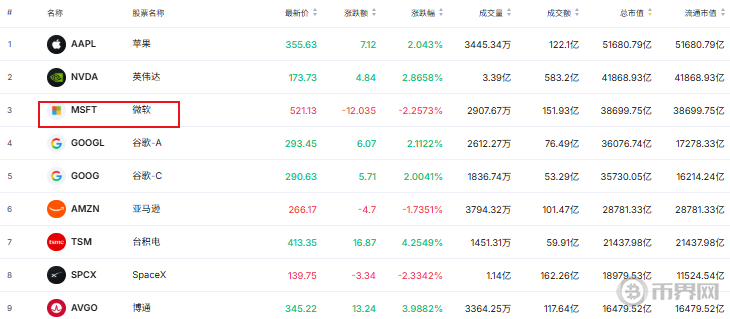
Latest price of Microsoft stock
In addition, Amazon, Microsoft, and Meta managed to maintain relatively stable stock prices during NVIDIA's decline. On November 12th, in the Asia-Pacific session: Amazon rose by 0.68%, Microsoft only fell by 0.26%, and Meta fell by only 0.56%. The post-market declines of Microsoft and Meta were less than one-tenth of NVIDIA's, while Amazon even closed higher against the trend.
Data also supports this point: Goldman Sachs still maintains its original forecast that global AI infrastructure capital expenditure will be $861 billion in 2026 and around $2 trillion by 2028, with the overall direction of expansion remaining unchanged.
What does the decline in NVIDIA's stock prices really change?
The impact of the decline in NVIDIA's stock on the AI industry is that it has exposed the bubble on the AI computing power chain:
The financing capabilities of new downstream cloud vendors are partly anchored on NVIDIA's credit endorsement. The valuation discipline in the primary market is influenced by the pricing sentiment of the secondary market towards NVIDIA, and global computing power supply expectations are highly tied to Jensen Huang's future at the company. It is recommended to pay attention to NVIDIA's board of directors' official decision next week, as well as the management's statements regarding customer needs and guarantee commitments in the financial report on November 17th; these will be a more direct test than any revenue forecast.
Frequently Asked Questions about NVIDIA Stocks
Question: Is the recent decline in NVIDIA's stock price the same as the bursting of the AI bubble?
They are not propositions of the same magnitude. The direct trigger for the decline was rumors of the board of directors' removal, which is a governance event.
Question: Will domestic chips immediately replace NVIDIA?
Answer: It won't happen immediately, but the window is opening. In 2025, the domestic market share of AI in China will exceed 40% for the first time, while NVIDIA's share will drop to 55%. The trend is clear. However, there are still three major constraints: HBM, advanced manufacturing processes, and the cost of ecosystem migration for CUDA. True substitution will depend on the stable operation of domestically produced chips in clusters with over ten thousand cards over the next 12 to 18 months, rather than a single spike in stock prices.
Question: Will things go chaotic if Jensen Huang leaves NVIDIA?
Answer: In the short term, it is highly unlikely that there will be a break in continuity, but confidence in financing will be impacted first. NVIDIA does not have a mature successor; dozens of senior executives report directly to Jensen Huang, and the corporate governance structure is highly flat.
Conclusion
The impact of the decline in NVIDIA's stock prices on the AI industry is not so much about the disappearance of demand for computing power, but rather that "key personnel risks" and "implicit guarantee relationships" have officially become part of the pricing framework for AI assets. Goldman Sachs' forecast for AI capital expenditures of approximately $2 trillion by 2028 has not yet been reversed, but the risk transmission pathways at a structural level have been rewritten.
The above content is an analysis of "NVIDIA's stock price fell by 9% after the release of new data; what impacts will NVIDIA's stock decline have on the AI industry?" For the latest news, please follow CoinMeta.
Disclaimer: Readers are kindly requested to strictly comply with the laws and regulations of their respective jurisdictions. The content of this article is compiled based on publicly available market information for reference only and is intended for informational purposes and learning research purposes only. It does not constitute investment advice.