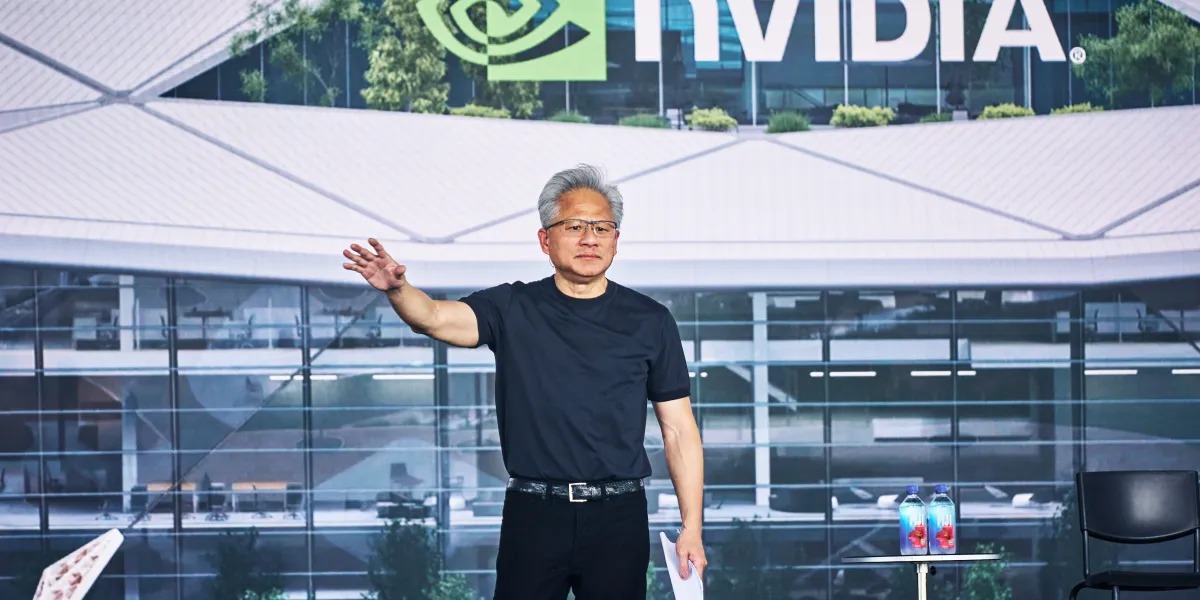
On Thursday, NVIDIA, which ranked first, fell by about 4%, with trading volume of $118.621 billion. NVIDIA announced on Thursday that Jensen Huang, co-founder and CEO, will resign from his positions as CEO, president, and director effective immediately. Collette Kress ( Colette Kress ), the chief financial officer, will assume the role of interim CEO, and the company's board of directors has also initiated a formal process to select a successor.
Jensen Huang's resignation is related to recent controversies surrounding his personal affairs. After the announcement, NVIDIA's stock price tumbled by about 14% at the opening, but the decline subsequently narrowed significantly. Investors are concerned that Jensen Huang's departure may affect NVIDIA's long-term technology strategy, customer relationships, and financing support for the AI infrastructure project.
NVIDIA's trading volume on that day was approximately 734 million shares, which is about five times the average level of the past 30 days, setting a historical record based on the transaction amount.
No. 2 on the list, Supermicro Semiconductor ( AMD ), saw a gain of about 7%, with trading volume reaching 31.579 billion US dollars. Changes in NVIDIA's senior management have prompted investors to re-evaluate the competitive landscape of the AI chip market. As one of NVIDIA's main competitors in the AI chip sector, AMD has become a focal point for capital attention.
The market believes that the management uncertainty faced by NVIDIA may prompt some large cloud computing customers to accelerate the diversification of their suppliers, creating opportunities to secure more AI chip orders for AMD. However, NVIDIA's existing software ecosystem and customer relationships still possess a strong competitive advantage.
3rd place, Micron Technology saw a decline, with transactions amounting to 21.076 billion US dollars. Jensen Huang's resignation has raised concerns in the market regarding NVIDIA's future product planning and AI infrastructure investments, affecting storage chip companies as well.
Micron is one of the world's major suppliers of high-bandwidth memory (HBM), and its products are widely used in (AI) servers. There are concerns in the market that if NVIDIA's future product launch plans or the deployment of (AI) infrastructure are affected, it could weaken the short-term demand for related storage chips. On the previous trading day, Micron's stock price soared by nearly 12%, so the pullback on Thursday also reflects investors re-evaluating the risks in the (AI) supply chain after a rapid rebound.
Broadcom, ranked 4th, saw a gain of about 5.4%, with trading volume reaching 15.699 billion US dollars. In sharp contrast to the decline in NVIDIA's stock price, Broadcom became an important rising stock in the AI chip sector on Thursday.
5th place: SpaceX completed transactions worth $13.459 billion. On Thursday, SpaceX announced plans to invest over $74 billion in building two supercomputing facilities in Texas and Arizona, USA, further expanding its AI computing infrastructure business.
Among them, the Starbase project in Texas is planned to invest over $24 billion, while the project in Arizona is expected to invest about $50 billion. The latter still requires approval from the local government.
In addition, Musk responded to suggestions regarding the hiring of Jensen Huang on the social media platform X, stating that it would be an honor for him. These remarks have sparked speculation in the market about possible future collaborations between Jensen Huang and Musk's companies, although there is currently no formal employment agreement in place.
Seagate, ranked 6th, saw a decline, with transactions amounting to 11.896 billion US dollars. Affected by changes in NVIDIA's senior management and a decrease in risk appetite in the AI industry chain, the storage sector generally faced pressure. Seagate had seen a significant increase of 13.69% on the previous trading day, but experienced a pullback on Thursday.
Tesla, ranked 7th, completed a deal worth $11.17 billion. The market is paying attention to Musk's public statement regarding Jensen Huang's resignation. Musk previously expressed his willingness to hire Jensen Huang, but did not specify whether it would involve Tesla, SpaceX, or any other companies under his umbrella, nor did he announce any formal recruitment arrangements.
Apple, ranked 8th, recorded a transaction of $10.842 billion. On Thursday, some funds shifted to large technology companies that were less directly affected by the NVIDIA incident, and Apple's stock price performed relatively steadily.
Previously, Bernstein reiterated its rating of Apple as "outperforming the market" and its target price of $380, stating that Apple is becoming a safe-haven choice in the technology sector. Analysts pointed out that Apple's capital expenditure accounts for only about 2% of its revenue, and by collaborating with external parties and using AI technology on the client side, it reduces its reliance on expensive data centers. Therefore, it is relatively less affected by the slowdown in AI infrastructure investment.
The 9th-ranked Google Class A shares ( GOOGL ) traded for $10.427 billion. Changes in NVIDIA's management have drawn more attention from investors to the development prospects of large tech companies' self-developed AI chips. Google continues to expand its tensor processing unit ( TPU ) business, and its self-developed AI computing platform is regarded as one of the important alternatives to NVIDIA GPU.
Microsoft, ranked 10th, completed a deal worth $9.329 billion. Changes in NVIDIA's senior management have prompted the market to re-examine the AI infrastructure investment and partnership of large technology companies. Microsoft is one of the important customers of NVIDIA AI chips and also one of the largest AI infrastructure investors in the world.
Amazon, ranked 11th, recorded transactions worth $9.057 billion. As a major global cloud computing service provider, Amazon continues to increase its investment in AI computing infrastructure. The market also pays attention to the growth of its AWS business, as well as the trend among large cloud service providers to reduce their dependence on external AI chip suppliers by developing their own chips.
12th place Nebius ( NBIS ) saw a significant drop in stock price, with trading volume amounting to 8.788 billion US dollars. Although the company's third-quarter results exceeded market expectations, its annual revenue forecast did not satisfy investors.
At the same time, the company plans to further expand its investment in AI infrastructure, raising the expected median capital expenditure for 2026 to approximately $27 billion, with capital expenditure expected to reach $40 to $45 billion in 2027. The delay in revenue recognition, combined with the massive investment plan, has exacerbated investors' concerns about funding needs.
The 13th-ranked Class C shares of Google ($GOOG) traded for $6.379 billion. Both Google's Class A and Class C shares made it into the top 20 in terms of trading volume. The market continues to pay attention to its self-developed AI chips, cloud computing growth, and AI infrastructure layout.
14th place: Meta Platforms traded $6.341 billion. The market is focusing on the AI infrastructure investments of Meta and its dependence on external chip suppliers. Meta is advancing the construction of AI models and data centers, while also optimizing computing power costs through customized chips and other methods.
15th place: CoreWeave fell, with trading volume of $5.935 billion. Changes in NVIDIA's leadership have put pressure on AI, a cloud computing infrastructure company, and CoreWeave is one of the companies that NVIDIA invests in and maintains close cooperation with.
CoreWeave previously announced revenue of approximately $3.661 billion for the third quarter, a year-on-year increase of 168%, which drove the stock price up by about 24.7% on Wednesday. However, subsequently, there were reports in the market that the company planned to raise at least $4 billion through loans. Coupled with sudden changes in NVIDIA's senior management, investors once again focused on its substantial capital expenditures, debt burden, and future financing costs, leading to a decline in the stock price.
Intel, ranked 16th, completed a deal worth $4.828 billion. After NVIDIA CEO Jensen Huang resigned, investors re-evaluated the previous investment and technical cooperation arrangements between NVIDIA and Intel.
NVIDIA previously announced an investment in Intel, with both parties planning to collaborate on data center and personal computing products. There are concerns in the market that a sudden change in NVIDIA's management could affect the progress of these collaboration projects, but there is no official information indicating any adjustments to their cooperation plans at this time.
TSMC, ranked 17th, completed transactions worth $4.571 billion. Changes in NVIDIA's senior management are putting pressure on its main chip foundry partners.
TSMC undertakes the important manufacturing tasks for NVIDIA's advanced AI chips, and its production capacity planning is closely related to the long-term needs of large AI chip customers. Investors are concerned whether NVIDIA's future product development and customer delivery plans will be affected by management changes. However, TSMC also serves Apple, AMD, and other large chip design companies, so its customer base is relatively diverse.
Maverick Technologies, ranked 18th, completed a deal worth $3.482 billion. Changes in NVIDIA's senior management have triggered fluctuations in the AI chip and data center networking equipment sector, drawing market attention to Maverick Technologies.
Lilly, ranked 19th, completed a deal worth $3.449 billion. The competition between Lilly and Novo Nordisk in the global weight loss drug market continues to attract attention.
The market is focusing on the sales growth of Eli Lilly's tirzepatide product, as well as the progress in the development of its oral weight-loss drugs. As more biopharmaceutical companies announce the results of clinical trials for new weight-loss drugs, investors are also re-evaluating the potential impact of future market competition on product pricing and profit margins.
The 20th-ranked company reported $3.255 billion in transactional revenue. On Thursday, after the U.S. stock market closed, the company announced its financial results for the fourth quarter of fiscal year 2026 and issued revenue guidance for the next quarter that exceeded market expectations.
The company reported revenue of $10.41 billion in the fourth quarter, exceeding market expectations of $10.3 billion. The company expects revenue of around $11.1 billion in the first quarter of fiscal year 2027, with a range of plus or minus $500 million, which is higher than the analysts' average forecast of $10.89 billion.
The company stated that the growing demand for AI chips will drive semiconductor manufacturers to increase investment in production equipment. Boosted by performance and outlooks, the stock price of application materials rose by about 3% after the market closed.