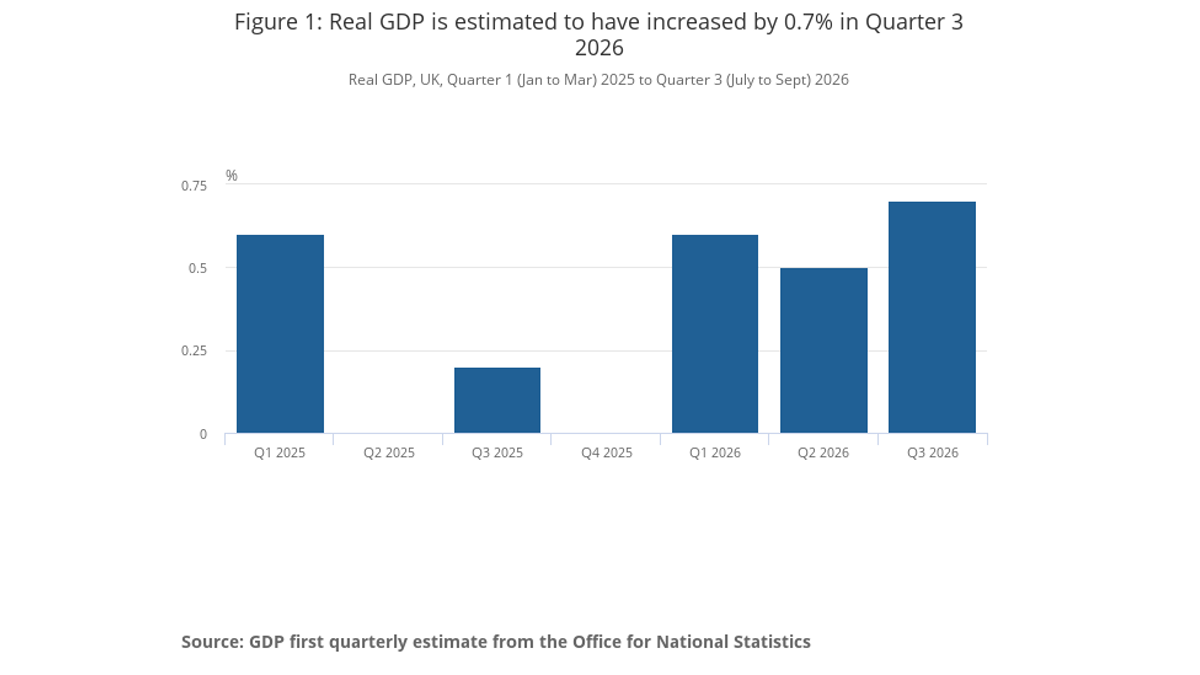


On November 12, the Office for National Statistics (ONS) of the UK released its preliminary estimates for the third quarter of GDP. From July to September 2026, real GDP grew by 0.7% on a quarterly basis, higher than the 0.5% growth in the second quarter; compared to a year ago, there was a growth of 1.9%. Per capita real GDP also increased by 0.7% quarter-on-quarter and by 1.7% year-on-year. These figures indicate that the economy continues to expand, but the growth is not uniform across all industries.
Service industry output grew by 0.9%, production increased by 0.1%, while construction declined by 0.7%. Thirteen out of twenty sub-sectors saw growth. Since the service industry accounts for a large proportion of the UK economy, the expansion of business services was sufficient to offset the decline in construction. To simply describe a 0.7% decrease as a “full recovery” would overlook the clear differences in trends between sectors.
Information technology and business services have become the main supports.
According to ONS, 11 out of 14 sub-sectors of the service industry contributed positively to growth. Administrative and support services grew by 4.1%, with leasing activities increasing by 6.6%; information and communications grew by 2.1%, and computer programming, consulting, and related activities grew by 4.4%. Professional, scientific, and technical activities were also significant contributors to positive growth.
Statistical agencies specifically mentioned that in 2026, many companies with significant increases in turnover were related to artificial intelligence and cloud computing. However, due to the methods of data collection, it is not possible to accurately quantify the contribution of these two areas. This limitation is important. It supports the notion that "AI and cloud-related companies appeared in the samples with faster growth," but it does not support the direct attribution of quarterly GDP growth to AI investments.
There has also been a decline within the service industry. Education, as well as accommodation and catering services, both saw a 0.5% decrease, with the latter being dragged down by a 1.9% decline in food and beverage services. The strengthening of business services and the weakening of consumer-facing activities can occur simultaneously, indicating that the demands from businesses and the experiences of households are not entirely consistent. When observing employment, wages, and consumption, it is necessary to separate different service industries.
The attempt to revive the market did not reverse the weakness in the construction sector.
The production sector only grew by 0.1%. Three of the four sub-sectors saw declines: mining decreased by 2.2%, power, gas, steam, and air conditioning supply decreased by 2.1%, and water supply, sewage, and waste management decreased by 1.5%. Manufacturing was the only sector that contributed positively, with a growth of 0.9%; among the 13 manufacturing sub-industries, 8 saw growth, with computer, electronics, and optical products manufacturing growing by 4.6%, which was the largest contribution.
The construction industry saw a decline of 0.7%, 1.7% lower than the same period last year. New projects decreased by 1.6%, while repairs and maintenance increased by 0.5%. The construction of new private residences fell by 4.7%, whereas repairs and maintenance of private residences grew by 1.5%. This divergence indicates that the maintenance of existing housing and new construction are in different cycles, and the overall state of the housing market cannot be summarized by just one total construction figure.
From the perspective of the expenditure approach, growth in the third quarter mainly came from household consumption and fixed capital formation. Domestic consumption grew by 0.6% after excluding net tourism. These preliminary estimates are still subject to revision as more complete surveys and annual balance data become available; therefore, businesses and investors should not regard these quarterly figures with decimals as final values.
The monthly rhythm is even more uneven than the quarterly titles.
In September, there was a 0.2% growth, while there was no growth in August, and the previously announced 0.1% growth figure was revised downward; in July, there was a 0.4% growth. The combined growth over these three months shows a relatively strong quarterly increase, but the trend was one of rapid growth at first, followed by a pause, and then a slight increase. Quarterly data can reduce the noise of individual months and may also obscure the changes that occurred during that period.
ONS provides a historical revision note: Since the first quarter of 2000, the average revision from the initial estimate to the final value three years later has been a positive 0.08 percentage points, with an average absolute revision of 0.27 percentage points. The average value cannot predict which direction this quarter will take, but it does remind readers that the initial estimate inherently carries uncertainty. Policy discussions should take into account both the direction, industry structure, and subsequent revisions.
The 0.7% growth in the third quarter of the UK is a clear sign of improvement, but it relies on the expansion of the service sector, particularly business-related services. Production remained nearly stagnant, construction and new private housing construction faced pressures, and consumer services did not generally show strength. What really needs to be monitored is whether this growth, driven by a few sectors, can spread to investment, housing, and household demand, rather than just waiting for the next time the overall figures to increase.
For policymakers, industry differentiation can also alter the effectiveness of the same policy. Business service companies may place more emphasis on talent and digital infrastructure, while the construction and housing sectors are more sensitive to financing costs, planning, and project delivery. Total growth cannot replace targeted judgment; subsequent employment, investment, and actual income data will determine whether this round of expansion has a broader foundation.