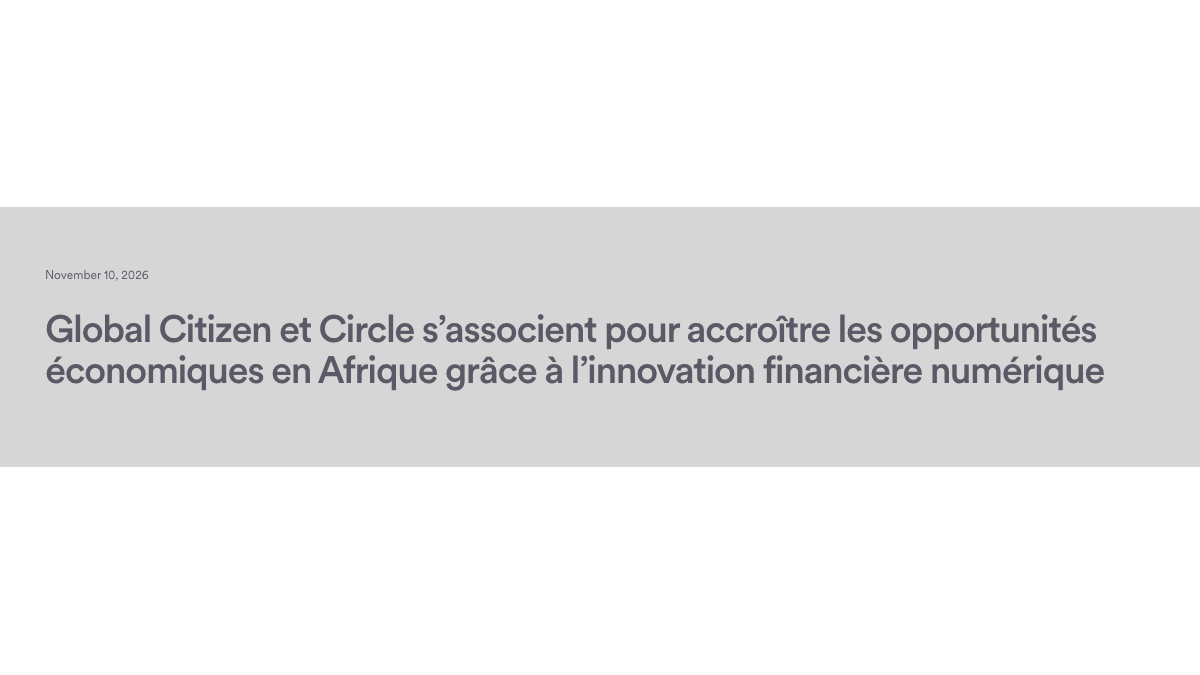


Circle and Global Citizen announced a multi-year collaboration on November 10th, planning to introduce USDC payments within the pan-African tour project Move Afrika. The first phase is expected to begin in 2027, starting in Rwanda, providing local suppliers participating in the event with new payment options. The announcement also includes financial and technical training, as well as exploring the use of digital payments to support public welfare fundraising and rewards for citizen participation.
This is not a large-scale payment migration that has already been completed. The partners have announced the scenarios, directions, and the initial implementation timeline, but they have not disclosed the number of participating merchants, the transaction volume, the specific fees, or the list of countries covered. To claim that "merchants in Africa are already fully using USDC" would exceed the planned boundaries ahead of schedule.
Behind each performance lies a cross-border supply chain.
Move Afrika is driven by Global Citizen and pgLang, creating local employment and entrepreneurial opportunities through annual live music events. Each performance requires production, stage setup, transportation, catering, security, creators, and other suppliers. Cross-border events often involve different currencies, bank hours, and cross-border fees, and the speed of payment collection directly affects the cash flow of small businesses.
The cooperation plan includes USDC as one of the payment options for participating suppliers, with the aim of faster payments, reduced transaction costs, and helping businesses engage in international commerce. The key point is that stablecoins should not automatically replace local currencies and banking channels. Merchants need to know how to exchange them, who will bear the exchange rates and fees, where their funds will be kept, and what tax and compliance requirements apply in their respective regions.
Circle will also support practical financial education, technical training, and guidance on the safe use of digital payments through Move Afrika Production Alliance. Training is not incidental publicity. Wallets, private keys, fraud identification, and the processes for depositing and withdrawing funds all affect whether merchants can truly benefit from these services. If the speed of receiving payments increases, but the risks of losing keys or making incorrect transfers are shifted entirely to small businesses, the technical benefits may be offset by new losses.
Stablecoins reduce one type of volatility, but they do not eliminate all costs.
USDC is designed to maintain a one-to-one value with the US dollar, but local suppliers may ultimately pay wages and make purchases in Rwandan francs or other currencies. The stability of the US dollar does not equate to the stability of local purchasing power; exchange rate differences, liquidity, network fees, and service provider rates can still affect the actual amount received. When evaluating pilots, it is necessary to compare the total cost from the time of payment to when the funds become available locally, rather than just looking at the time of on-chain transfer.
Payment also involves identity and compliance. Event organizers need to verify suppliers, service providers may require customer identification, and cross-border funds are subject to local regulations. Blockchain records can improve the traceability of certain processes, but they do not automatically handle tax declarations, sanctions screenings, or contract acceptance. The most reliable approach is to integrate on-chain payments with clear supplier management, rather than relying on wallet addresses to represent all business identities.
The announcement mentions Global Citizen and Circle Impact Champions Award. Circle will provide funds to eligible non-profit organizations through USDC. Both parties will also explore moving community participation and reward programs onto the blockchain. However, this is still in the exploratory and qualification-defined phase; it cannot be assumed that all public welfare funds have already been moved onto the blockchain. The design of the rewards also needs to prevent spamming, account trading, and regional exclusions.
The pilot project in 2027 needs to be accepted based on actual funds received.
The most valuable validation of this collaboration is not how many promotional wallets are issued, but whether suppliers can obtain available funds more quickly and at a lower cost. Observable indicators include payment completion time, failure rate, exchange costs, support requests, fraud losses, and the proportion of merchants who continue to use the service. It is also necessary to compare the stability of the cryptocurrency path with the existing bank and mobile payment paths to determine where the improvements come from.
choices must also be respected. Some merchants may be more familiar with local mobile payments or bank accounts, and forcing them to use new tools would increase barriers to entry. Only by providing parallel options, clearly disclosing fees, and allowing for a safe exit can the pilot programs reflect real user needs. Digital literacy training should also cover alternative solutions when stablecoins are not used, rather than turning education into a one-way promotion.
Circle and Global Citizen have put stablecoins into a concrete and verifiable supply chain scenario: the payment to local suppliers for on-site performances in Africa. This is closer to practical problems than abstract discussions about "financial inclusion," but the actual results are still to be seen in the future. By 2027, what really needs to be answered is whether small businesses can receive money more quickly while taking understandable risks, rather than just whether there are more addresses on the blockchain.