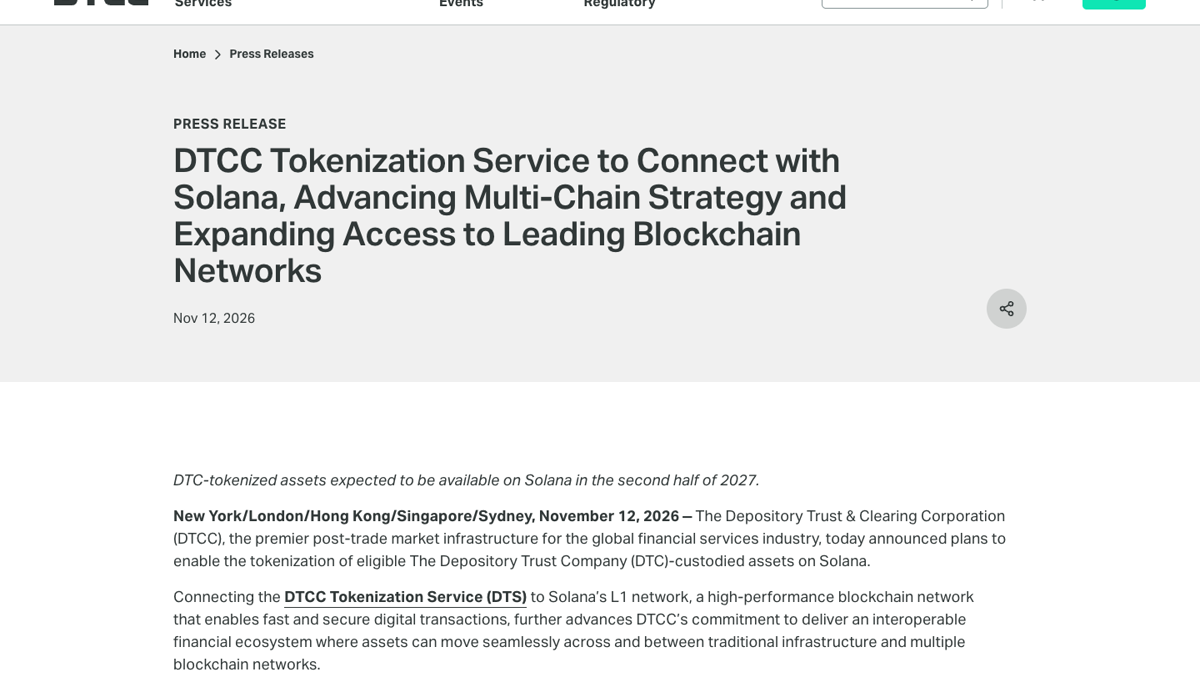


On November 12, the U.S. Securities Market Infrastructure Agency DTCC announced plans to connect its Tokenization Service with Solana, enabling eligible assets held by DTC to be tokenized on the blockchain. The official timeline points to the second half of 2027. The announcement describes the construction plan, not that all U.S. stocks can already be freely traded on Solana.
One of the core functions of DTCC is to serve as the infrastructure for custody, clearing, and settlement in traditional securities markets. It connects the representations on the chain with the assets held by DTC. The focus is not just on making token transfers faster, but also on ensuring that the rights, ownership records, and regulatory protections associated with these tokens remain interpretable. Without this layer, tokens on the chain might merely be certificates related to securities prices, and they would not equate to investors possessing the same legal rights.
On-chain speed must comply with the consistency of asset registration.
Tokenization Service was launched on October 28th, and DTCC claims to maintain traditional ownership, investor protection, and regulatory safeguards. After connecting to Solana, there must be consistency between on-chain transfers and underlying custody records: an asset cannot be represented multiple times across different systems, and it is also necessary to clarify which record has ultimate validity during redemption or freezing processes.
The most challenging part of such systems is not token generation, but rather handling exceptions. On-chain transactions may be confirmed quickly, while traditional systems may be undergoing maintenance, compliance reviews, or corporate actions. If the states on both sides are temporarily inconsistent, there needs to be mechanisms for pausing, reconciling, and resuming operations. The faster the speed, the faster errors can spread; therefore, stable identifiers, idempotent operations, and complete audit logs are essential components of the infrastructure.
"Eligible assets" are also a key restriction. The announcement does not state that all securities held by DTC will be made available simultaneously, nor does it provide a specific list of assets, investor access requirements, or arrangements for trading venues. Different securities are subject to the issuer's consent, transfer restrictions, market rules, and regulatory requirements. To interpret the plan as "comprehensive listing of U.S. stocks on the blockchain" would be an overextension of the official information.
Solana obtains a connection plan, not a unique settlement layer.
Solana provides a high-performance public blockchain environment, suitable for near-real-time transfers and programmable asset operations. However, DTCC will not abandon traditional recording and control just by connecting to one chain. The announcement emphasizes maintaining the existing protections, indicating that the public chain is a new technical channel, not the sole source of legal ownership.
For issuers and financial institutions, the potential benefits include longer service lifetimes, faster collateral transfers, and programmable corporate actions. The actual benefits depend on whether participants adopt common standards, as well as whether the cash side, identity management, compliance, and reporting systems can work together seamlessly. Having securities on-chain while funds are settled according to a different timeline may not completely eliminate all frictions.
For the public chain ecosystem, the entry of institutional assets also raises operational requirements. Node failures, congestion, program vulnerabilities, and key management issues can all affect high-value assets. Traditional markets already have processes for suspending transactions, correcting errors, and disaster recovery; however, on-chain solutions need to re-express these capabilities, rather than assuming that immutability automatically means no errors.
The two-year construction period indicates that the actual work is carried out outside of the interfaces.
From the announcement in November 2026 to the planned implementation in the second half of 2027, there is a relatively long construction period in between. What needs to be completed is not just code integration; it also includes asset qualification, participant testing, operational processes, regulatory communication, security audits, and failure drills. The schedule itself indicates that this is not a simple cross-chain deployment.
There are three key things that investors need to distinguish clearly: who manages the underlying securities, what rights the tokens on the blockchain represent, and who will handle situations such as forks, misdirected transfers, or account restrictions. If a product only emphasizes 24/7 availability and fast settlement but fails to address these issues, the technical convenience may obscure unclear rights.
The significance of connecting DTCC to Solana is that traditional market infrastructure is beginning to reserve formal interfaces for public chains. It has not been announced that the securities market has been fully migrated, nor has regulatory protection been automatically incorporated into each wallet. The acceptance criteria for the next phase should not merely focus on whether tokens can be created, but rather on whether the state on the chain and the custody records are consistent over the long term, whether anomalies can be stopped, and whether investors' rights can be accurately explained at every stage.
The market also needs to see how the company will handle these situations. Dividends, stock splits, voting, pledges, and judicial freezes can all change the status of assets, and their representation on the blockchain must be synchronized with registration, tax, and notification processes. If normal transfers are quick, but exceptional events can only be manually corrected, the operational costs of the system may shift from routine settlements to a few but high-risk scenarios.