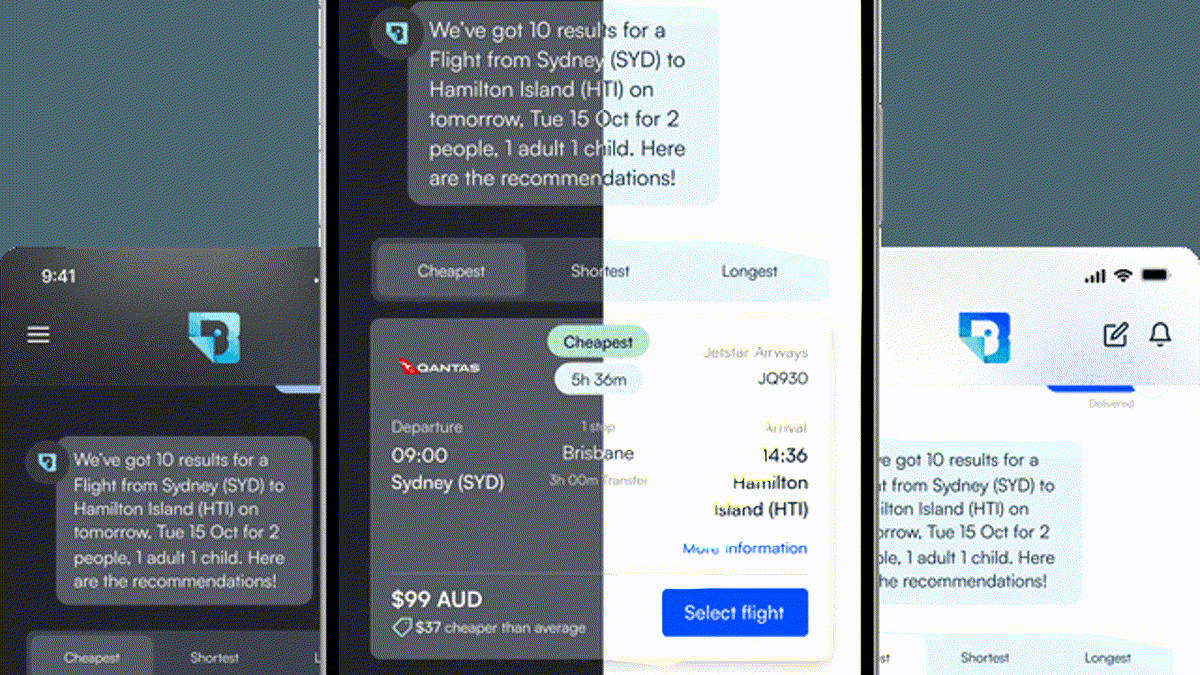


It's not new for travel assistants to recommend flights, but the real challenge is to turn those recommendations into actual tickets. On November 12th, Mastercard announced that it had completed an end-to-end AI booking process in collaboration with Travelport, Booked AI, and Basis Theory. Users outline their travel plans in a conversation, the intelligent agent searches for flights that meet the new distribution capability standards, displays the prices, and then proceeds with confirmation, followed by payment and ticket issuance. The entire process avoids the need for users to fill out forms on traditional web pages page by page.
The focus of this demonstration is not on the chat interface, but on how the four systems work together. Booked AI is responsible for understanding travel requirements and maintaining the conversation, Travelport provides sellable flight information and order functionality, Mastercard Agent Pay offers tokenized payment vouchers, and Basis Theory handles secure payment data connections. If any one of these steps is not completed correctly, a ticket cannot be legally and accurately assigned to a user's name.
Paying with a voucher does not equate to handing over one's bank card to an intelligent entity.
According to Mastercard, the underlying bank card information has not been exposed to the AI entity. The system provides restricted tokenized vouchers for this purchase, and the transaction is still processed by the airline as the merchant. This structure separates the capabilities of the "entity to make payments" from the entity's ability to "see or permanently store card numbers," thereby reducing the scope of accidental exposure of sensitive data by models, third-party plugins, or logs.
More importantly, it is necessary to verify the user's intentions. The flight and ticket price confirmed by the user must be bound to the transaction; if the final submitted information does not match the authorized details, the system should prevent payment. Traditional e-commerce platforms usually allow users to check one last time on the checkout page, whereas conversational agents may continuously call multiple APIs in the background. By converting the confirmation process into constraints that machines can verify, it is possible to prevent transactions from proceeding even in cases of changes in ticket prices, seat replacements, or misinterpretation of parameters.
This does not mean that the risks have disappeared. Travel products include information such as names, documents, luggage, cancellation and rebooking policies, and layover conditions. A successful payment does not guarantee that all fields are correct. If an agent selects the wrong airport, date, or ticket price type, tokenization can only protect the payment details but cannot automatically correct travel decisions. Reliable products still need to display key fields at irreversible nodes, so that users know what they have purchased, who issued the ticket, what the total cost is, and how to cancel it.
The merchant relationship has not been redefined by AI.
The announcement emphasizes that airlines remain merchants, which defines the boundaries of after-sales service and responsibility. While intelligent agents can streamline the search and booking process, the transportation services are still provided by airlines, and inventory and ticketing rules come from travel distribution systems. Refunds and disputes cannot be simply delegated to chatbots either. Just because the interface has been simplified to a single statement, it does not mean that the underlying contractual relationships disappear.
For travel platforms, proxy purchasing shifts competition from the page itself to the capabilities that can be utilized. In the past, platforms influenced users' choices through filters, sorting options, and checkout pages; in the future, whether flight information is structured, prices are updated in real-time, and whether refund and modification rules can be accurately interpreted by machines will determine whether a platform qualifies to be considered for integration with intelligent agents. As the visible display layer becomes less important, data quality and interface management become even more crucial.
This also brings new auditing issues. A single order may involve models, travel content platforms, payment credential services, and airlines. When errors occur, it is necessary to restore the user's original statements, the options displayed by the system, the prices at the time of confirmation, the fields actually submitted by the agent, and the payment authorization. Only when each step has traceable records can customer service and dispute resolution determine where the first discrepancy occurred.
From demonstration to a commonly used service, there are still three hurdles to overcome.
The first hurdle is price fluctuations. Air ticket inventory can change rapidly, and there may be discrepancies between search results and the final payment. The system must clearly define which changes require re-confirmation; it cannot interpret the general request "book the most suitable one for me" as an unlimited authorization. The second hurdle is identity verification and compliance. Different routes have varying requirements for passenger information, payment validation, and sanctions screening, so agents cannot use a single demonstration to cover all regions.
The third step is failure handling. Ticket issuance may be delayed, payments may succeed but the order status remains unclear, and network interruptions can also leave users unsure whether they have completed a purchase. If agents blindly retry without knowing the outcome, this could result in duplicate tickets or double charges. A stable order identifier, idempotent requests, and clear confirmations are more important than whether the model's responses sound like those of a real person.
This joint demonstration has proven that AI is now capable of advancing the process from "searching for flights" to "obtaining tickets" within a controlled framework. However, it does not mean that all travel activities can be carried out without supervision, nor does it eliminate the need for users to make final confirmations. The real breakthrough in the product lies in the integration of payment receipts, purchase intentions, and merchant orders into a verifiable chain. AI Travel Assistant will only become a trustworthy transaction entry point when it is able to reject inconsistent transactions, explain failure scenarios, and provide the option for manual withdrawal.