Asian stock markets are approaching an extremely oversold level, while the rapid accumulation of short positions in the U.S. stock market is shifting the market's risk from a "downward gap" to a "short squeeze" risk. UBS advises investors to shift their strategic focus from defense to offense, buying on dips, and to pay particular attention to the structural opportunities in the semiconductor sector relative to the software sector.
According to ZuiFeng Trading Desk, UBS strategist Zain Nizami pointed out in the latest report that both defensive positions and aggressive short-selling strategies have been profitable over the past two to three days. However, various price movements and position indicators indicate that these trades have become significantly overextended. The Hang Seng Tech Index is currently 23% below its 200-day moving average, with RSI falling to 27; the RSI of the CSI 300 also dropped to 23.9, hitting a historical low, while testing the support of the weekly 200-day moving average.
Nizami indicates that, considering the current sentiment, position status, and the macroeconomic headwinds that have already been absorbed by the market, 'continuing to maintain a thoroughly bearish and defensive stance is becoming increasingly inappropriate.' The current risk-reward ratio favors buying on dips rather than aggressively pursuing further short positions. However, he also warns that macroeconomic risks and correlation risks have not completely subsided, and the market has not seen a classic wave of panic selling. This means that it is not yet appropriate to fully switch to a 'risk-on' mode.
Asian stock markets deeply oversold, European markets locally overheated
There was a significant sell-off during the Asian-Pacific trading session on Thursday, and considering the subsequent financial reports and geopolitical information, the decline seems disproportionate to the fundamentals. The Hang Seng Tech Index RSI fell to 27, representing a 23% discount from its 200-day moving average, and UBS characterized this as "extremely oversold." The CSI 300 also came under pressure, with RSI hitting 23.9, level with its historical low, and is currently testing key moving average support.
The Hong Kong market absorbed the majority of the selling pressure, with the Hang Seng Index experiencing an "overwhelming decline day" where 95% of the stocks fell; in South Korea, KOSPI, the decline was equally severe, with 627 stocks falling and only 152 stocks rising.
In contrast, some European markets have shown signs of local overheating. According to UBS data, approximately 40% of the constituents in the Swiss SMI index and about 25% of the constituents in the German DAX index (mainly driven by the insurance sector and SAP related exposures) have exceeded 70, entering a technically overbought area.
Macroeconomic headwinds and correlation risks remain concerns
Nizami points out that current market sentiment is still dominated by cross-asset dynamics. High oil prices, widening spreads in French and German government bond yields (the OAT-Bund spread), and rising yields on sovereign bonds have collectively created a risk-averse atmosphere recently – although the inflow of risk-averse funds has led to some decline in yields. Political and geopolitical news fluctuations have further exacerbated the aforementioned trend.
At the same time, cross-asset correlations are rising again, and the relative value relationship between semiconductors and software has approached extreme levels. UBS believes that the next potential risk is not a continued significant decline in the market, but rather the concentrated release of positions in crowded sectors due to increasing correlations—this reversal in price relationships and narrowing of market breadth deserves high vigilance against the backdrop of continuously growing bearish interest.
High short positions in U.S. stocks, and the squeezing of risks cannot be ignored
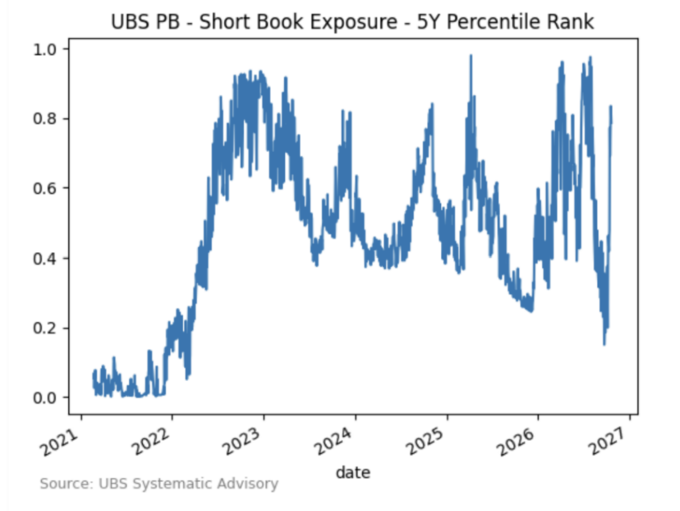
Data from UBS's Systematic Strategies department ( Systematic Advisory , led by Amandine - Parisa Kara ) shows that the scale of short positions in the US stock market has significantly increased, both in absolute terms and relative to the same periods in previous years. Nizami believes that most of the pressure for position adjustments may have been released, and the risk of the market squeezing shorts upwards is accumulating, which is greater than the risk of further declines.
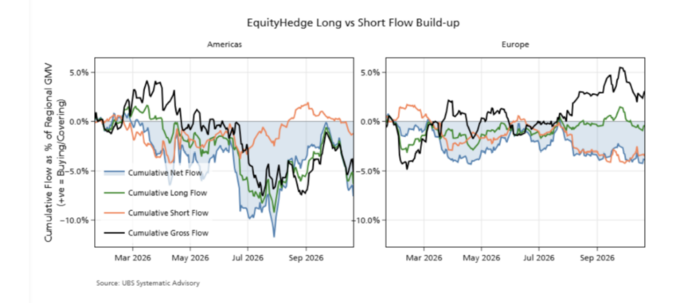
From the perspective of capital flow, long positions in U.S. stocks continued to reduce their holdings at an accelerated pace, while there was a slight increase in short selling (for hedging purposes); in Europe, there was a defensive net inflow. UBS' data on high-impact capital flows also indicates that the previously overwhelming defensive capital flows have begun to subside, with institutional trading becoming more situational and focused on individual stocks.
Semiconductors versus software: Structural opportunities worth paying attention to
Within the technology sector, the reduction of positions in the semiconductor and semiconductor equipment sectors has significantly accelerated, and signs of deleveraging are also beginning to appear in the hyper-large-scale cloud computing (Hyperscaler) sector. Nizami believes that there is an attractive strategy at present: to go short on hyper-large-scale cloud computing, cover one's long positions in semiconductors, or to construct a relative value strategy between the two using proportional hedging.
Overall, UBS's advice can be summarized as follows: The conditions for a full-scale offensive are not yet met, but the risk-reward ratio of buying on dips is improving. The focus of the strategy should shift from "selling on rebounds" to "buying during pullbacks," and the structural opportunities in semiconductors, relative to software, deserve priority in investment allocation.
~~~~~~~~~~~~~~~~~~~~~~~
The above wonderful content is from the Chasing Wind Trading Platform.
For more detailed interpretations, including real-time analysis and frontline research, please join [Chasing the Wind Trading Desk ▪ Annual Membership].