


On November 12th, local time, at the 2026 Robot Learning Conference held in CoRL, Li Feifei, the founder of World Labs and also known as CEO, engaged in a dialogue with Su Zifeng, who serves as the chairman of AMD and is also referred to as CEO. They exchanged views on topics such as physical AI, robot development, computational power requirements, and future model directions.

Li Feifei believes that robots will drive computing power into the next stage of development; Su Zifeng, on the other hand, suggests that the physical AI field, especially in the robotics sector, may become a market worth hundreds of billions of dollars in the coming years.
This conversation was moderated by Peter Stone, the organizer of the CoRL conference. It was also the first time that Li Feifei and Su Zifeng publicly communicated together after AMD announced its acquisition of World Labs.
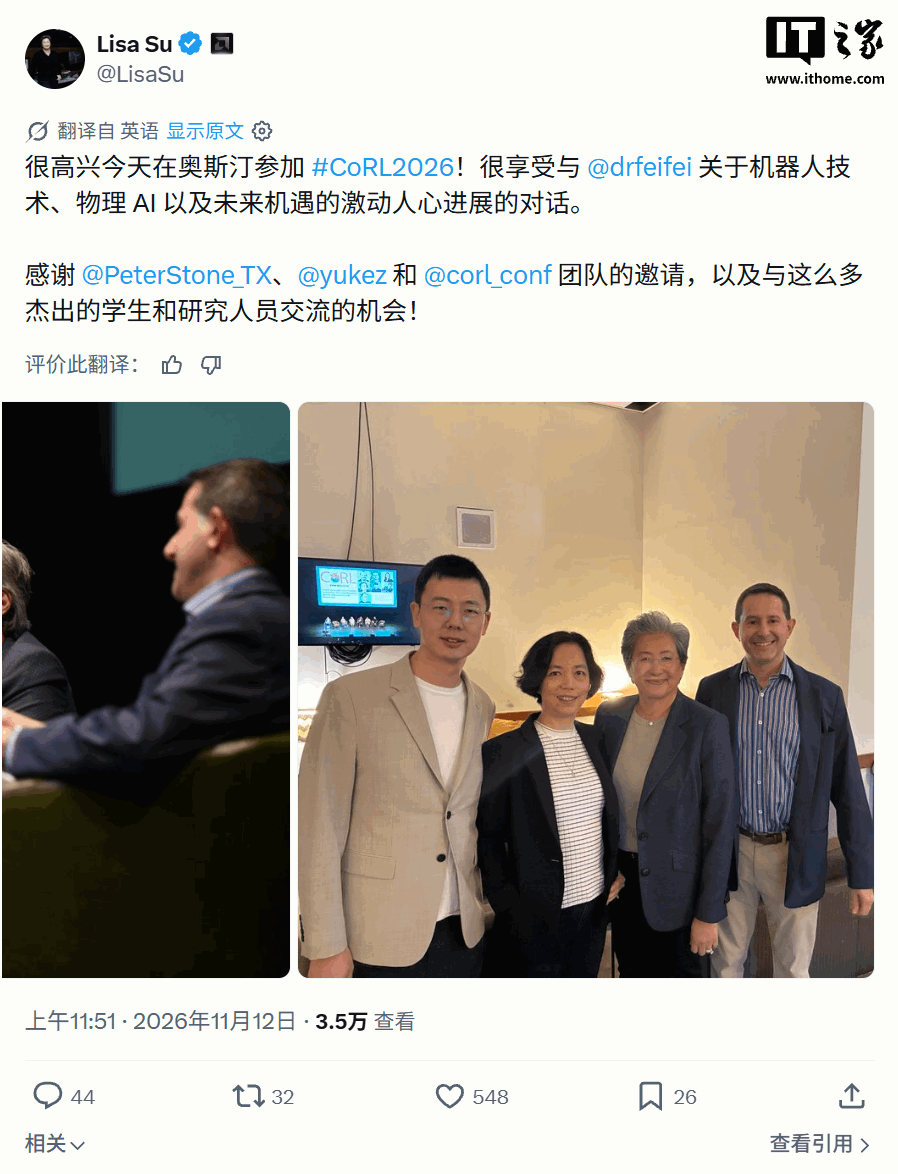
CoRL According to the official agenda for 2026, Li Feifei also delivered a keynote speech titled "Atlas: A Unified World Model for Generation and Reconstruction" on that day, introducing the latest research achievements of World Labs in the field of world models.
When discussing the prospects of the robotics market, Su Zifeng stated that artificial intelligence is still in its early stages of development, and particularly in the field of robotics, there are tremendous opportunities. The market size could reach hundreds of billions of dollars in the coming years. She believes that robots need to truly understand physical laws, models, and their surrounding environment, and that the collaborative optimization between hardware, software, and systems will play a crucial role.
Su Zifeng also stated that AMD already has a considerable physical AI and robotics research team, although the related layout is still in its early stages. AMD already possesses technologies such as embedded FPGA, processors, and AI engines, which can support industrial robots and other equipment. In the future, the company hopes to further strengthen cooperation with universities, startups, and research institutions to promote the development of the robotics technology ecosystem.
Regarding the development direction of the AI model, Li Feifei put forward the view that " AI is computing, and computing is AI." She believes that there is a trend of integration among world models, language models, and multimodal models, and both hardware and software need to evolve together.
When discussing the application of large language models and visual language models in the field of robotics, Li Feifei stated that these models will play an increasingly important role, but at present, it cannot be assumed that the systematic problems in the field of robotics have been solved. Robots need to interact directly with the physical world, and there are still a large number of technical issues that need to be explored.
Su Zifeng stated that different application scenarios require different types of models, and there is no single model or technical approach that can solve all problems. In some scenarios, cutting-edge large language models may perform exceptionally well, while in other scenarios, specialized models may have more advantages.
Computing power requirements are also an important topic in this discussion. Su Zifeng believes that the development of robots will further drive the demand for various forms of computing capabilities, including cloud computing power for model training, internal computing resources of enterprises, edge computing, and computing devices deployed directly in physical environments.
She pointed out that in the future, computing capabilities of different scales and forms will be needed, and overall efficiency should be improved through the collaborative optimization of hardware, software, and systems. As robots increasingly enter real-world environments, indicators such as low power consumption, high efficiency, and low latency will also become more important.
Li Feifei emphasized that robots will drive computing power into the next stage of development, and this demand exists not only on the model training side but also extends to the field of edge computing. She believes that the past development of robots faced many difficulties because devices had to understand and interact with the physical world, but the current development of AI technology is bringing new opportunities to this field.
The two also discussed the issue of academic research institutions obtaining computing resources. Li Feifei believes that during the critical period of the rapid development of AI, it is very important to provide sufficient computing resources for public departments and academic researchers. She mentioned the previously promoted U.S. National Artificial Intelligence Research Resources Act ( NAIRR ), with the hope of using public resources to support researchers in conducting AI evaluations, benchmark tests, and other work.
Su Zifeng expressed agreement with this, stating that AMD is building computing capabilities reaching several terawatts in scale. She believes that industry companies should allocate some of their computing resources to long-term research and make them available to universities and the next generation of innovators, to help more researchers participate in technological development.
In addition, Su Zifeng revealed that AMD already has a physical AI and a robotics research team. In the future, they hope to further strengthen related research with the addition of Li Feifei and World Labs, and to establish connections with the entire robotics ecosystem.
This conversation also touched on the issues of AI power consumption and model efficiency. Su Zifeng believes that reducing power consumption, improving efficiency, extending lifespan, and lowering latency are all directions that future computing technologies need to continuously optimize. Li Feifei, on the other hand, stated that the high energy efficiency of the human brain is the result of billions of years of evolution, and it cannot be simply compared to the training power consumption of current AI models. Moreover, AI is not necessarily just aimed at replicating the human brain.